Friday, November 16, 2012

Harvest Festival

These are all the bands that I will be enjoying today (listed in terms of how excited I am for them in increasing order):


and last but not least....


Yes - it reads a little like the best hits of the 90s with a few random recent bands in there too. I'm going to love it.

Have a happy Saturday!

Thursday, November 15, 2012

Day 16: Over halfway...

Ever felt like this?

I had a tiny-little-mini-freakout last night when my phone inexplicably died. One minute it has 40% battery, next minute it is black screen and unresponsive. Not even the hold-the-power-and-home-buttons-down-and-cross-all-your-fingers-and-toes was working. This was the last thing I needed, which is partly my fault, but more on that another day. My to do list at the moment is actually a full A4 page long, with a lot of stuff that involves money and paperwork (everyone's favourite), and I'm planning on heading to Sydney* this weekend to see a festival which I have done absolutely no organising for in true current Libby style. (Thankfully, eventually my phone started working again!)

So today I'm going to not push myself too much and leave you with a short video with stories from some women with endo. It's worth the watch just for the sweet kiwi (New Zealander for all you non-Aussies) accents.


*to all the potential robbers out there that may read my blog and potentially know where I live - nice try, but I have housemates who will be home this weekend...
_________________________________________________________________________________

This month I will be taking part in National Health Blog Post Month. Check back every day to see the new topic and learn more about endometriosis. Today's prompt is to use a picture or video to inspire a post.

Movie Roundup

I've seen a lot of good films lately due to the Canberra International Film Festival (CIFF) being on. I'm generally fairly hard to please when it comes to movies so I was quite surprised when two of the movies I've seen in the last few weeks have made me want to go out and buy the DVD. So if you're looking to see a good movie check these two out:

Poster courtesy of IMDB
I saw this movie last night as part of my CIFF membership. It details the final year of a coach's run of coaching at Mannassas Highschool in Memphis, Tennessee and the stories of some of the kids on the team. It will make you bawl while you are grinning your face off. It's out on DVD, so hightail it to your DVD store and check it out.

_______________________________________________________________________________

Poster courtesy of IMDB
This movie is still in theatres in Canberra so hopefully it is where you are too, because you should go and see it! It is based on the true story of a quadraplegic man in France (yes, it has subtitles), the man he hires to care for him and the hijinks they get up to together. I loved every second of this movie. Stellar acting by both of the leads. For those who have known me for a long time, take note of the fact that it almost beats 500 Days of Summer in how much I love it. That is a big statement for me...


Wednesday, November 14, 2012

Day 15: Nominations for the WEGO Health Activist Award

Today's NHBPM prompt is to nominate someone for a Health Activist Award & explain why you nominated them.

I've chosen two blogs to nominate for the awards - Endohope and Mind Your Body.


I nominated Endohope for the Best in Show: Blog Award (Someone who exemplifies the use of blogging.) Michelle's clear and concise blogging style gives practical tips for living (not just surviving) with endometriosis. The blog lives up to it's name and you are definitely filled with hope upon reading. This blog is one of the reasons I decided to start blogging about endometriosis.


I nominated Mind Your Body for the Silver Stethoscope award (A healthcare professional who utilizes social media to make the world a better place). 
The people at Mind Your Body epitomise the attitude that I believe healthcare professionals should have towards patients with chronic conditions. Their empathy shines through.

Nominations are open until December 31st, 2012.
_________________________________________________________________________________

This month I will be taking part in National Health Blog Post Month. Check back every day to see the new topic and learn more about endometriosis. Todays' prompt is to nominated someone for a Health Activist Award and write a post about why you nominated them.

Tuesday, November 13, 2012

Day 14: Tips for visiting the doctor

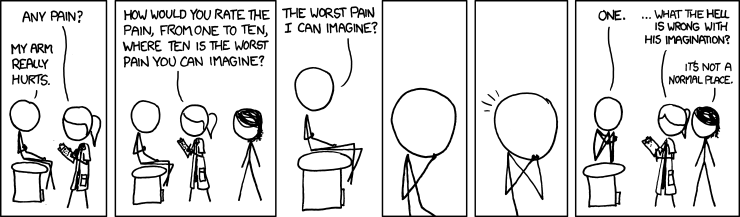
Comic thanks to xkcd
1) Have a pain/symptom diary and know what the symptoms of endometriosis are.

When I visited the Canberra Endometriosis Centre (a centre that I highly recommend if you are in the ACT area) after my diagnosis I had a meeting with one of the nurses there. She listed off a number of symptoms and asked me if I had them and to what degree they affected me. Some of the list I had always thought were normal before - like constipation or diarrhoea with your period, pain with bowel movements and painful urination, as I had had them for as long as I could remember and so never thought any different. (And when you do ever talk about these things with anyone? For all I knew, they were normal!) After she pointed them out to me (and this could be seen as a bad thing, I guess), I noticed just how often I experienced these symptoms.

It's important that your doctor knows all of your symptoms and how often you experience them, so they can judge whether it might be endometriosis or something else, like irritable bowel syndrome. I often found that when I was not in pain it was easy to forget how bad it was and I ended up playing down the severity of it to the doctor. It's important to record your pain while you are having it so that the doctor gets the full picture.

Pain/symptom diaries can also be handy when trying to plan your life around when you are likely to get pain. If your pain was fairly predictable like mine (most months it was the 7 days before my period, and the first few days of my period, as well as a day or so for ovulation), you can then plan to take it easier and get more rest during that time by scheduling less activities.

Pain/symptom diaries are also useful when trying different treatments to see if the treatment is actually having an effect.
Pain scale thanks to Hyperbole & a Half
Useful things to include in a daily pain/symptom diary include:
  • intensity of the pain on a 1-10 scale. (this is hard at first because it is very subjective but at the same time it is useful for communicating differences between different pains to your doctors)
  • location of the pain
  • type of pain (eg dull ache, pulling, tugging, sharp twinge, tenderness, throbbing, contraction-like)
  • any time dependence of the symptoms (eg worse in morning, better in evening)
  • triggers (eg overdoing it, stress, drinking coffee, spicy food, forgetting to take supplements, not doing enough exercise)
  • remedies and whether they were effective (eg hot water bottle, exercise, different medicines)
To keep record of your pain you can use a chart or app. I use My Pain Diary Lite from the App Store. (There is also a paid version for $5, but I find the free version works just fine.)


2) Be aware of your options.

Read as much as possible about endometriosis and pelvic pain itself and the treatment options out there. One of the problems with getting treatment for endometriosis is that many doctors aren't aware of the less invasive methods that can be tried first before the more extreme surgery option. Some people can manage their endometriosis using hormonal methods (such as the Pill, Mirena or Implanon) or through diet, supplements and exercise, and surgery is not needed, so it is important to explore these pathways first.

When it comes to surgery, excisional surgery is the "gold star" treatment. Not all surgeons do this surgery so find a surgeon in your area who does it, or consider going elsewhere for surgery.

Other treatments for pelvic pain include acupuncture, yoga, and pelvic flood physiotherapy to relax the muscles. A holistic view to health including treating associated depression and anxiety may also improve pain.

There are many resources for learning about different treatments out there. There are a number of different blogs like the ones listed in this post or books like Susan Evans' Endometriosis and Pelvic Pain (free e-booklet available, but the book is also well worth the money). Check 'em out!


3) Don't be afraid to push for treatment.

I only got diagnosed and treated for endometriosis because I went to my GP and told her to give me a referral to a gynaecologist I had heard was good. Once I went to that gynaecologist he basically left it up to me whether I wanted to have the surgery or not (not that he gave me another option for treatment other than having a baby, I can't say he was the best gynaecologist after all).

Before this, I had a few different doctors who tried a few different things. I had one doctor that did a pelvic ultrasound and when that came back clear, he sent me on my way. Do not accept this. Endometriosis can never be ruled out by ultrasound. I have stage III endometriosis and it didn't show anything. Another doctor I had put me on the Pill for pain, but it didn't work and just gave me worse symptoms than before.

What I'm trying to say is, if one doctor will not help you, keep going, try other doctors. Ask friends for recommendations. Search the internet for endometriosis specialists in your area, and read the reviews. Of course, internet reviews should always be taken with a grain of salt, but generally, if your doctor is getting averages of 2.5 stars, then you're probably not going to have as good an experience as you would with a doctor who averages 5 stars.

I had to be persistent and brave the setbacks. The sad fact is that you probably will have to too, but just know that if you persist, you may get answers and things might just get better.

I'm still having to do this now, even after diagnosis. When I told my doctor that I have bladder pain she tested me for a UTI, and when that came back negative, she didn't keep investigating. I've brought it up again at subsequent appointments and she has referred me to another doctor to keep investigating.

4) Have realistic expectations.

If you have pelvic pain, it may not be completely fixed by whatever method of treatment your doctor uses. I think that if the doctor had told me that surgery didn't always work, I may have had an easier time recovering mentally from the diagnosis and the operation. It's important to know that you may actually have to live with at least some pain for the rest of your life. Hopefully not, but at least this way you are not let down.

5) Have a plan of what you want to discuss with your doctor.

This should probably be number one on the list - you generally only have 15 minutes that you may have to wait a few months for, so make it worth your money and time! I generally make a list of my concerns and take it with me to the appointment - I also have a folder dedicated to all of my health related paperwork. Rehearse your first few sentences if you need to, just so your doctor knows exactly what you are concerned about and why you have come to see them. Doctors see a lot of patients and you want them to do the best job possible for you, so help them out a bit and make it clear what your concerns are.

I know for me, this tip has made my life much easier - lately I've been going to at least one appointment a week, more often two, so it's important that it's worth the time I take out of my work day.

6) Know that you are the one in control.

No doctor should force you to try any treatment you are not comfortable with. It is your body and you are the one that will have to deal with any repercussions, not the doctor. Also, you need to be the one to be active and involved in your health - a doctor can talk to you all day about how you should do this or that, but in the end, you need to be the one that makes productive steps to improve your health.


For more tips go to this post in Mind Your Body - a blog focussed on managing the mental health of chronically ill patients by two psychologists in the US. Just shows that there are some really great doctors out there - don't give up hope!

Also stay tuned - later this month there will be a post with tips for health care professionals and caregivers for dealing with people with endometriosis.

_________________________________________________________________________________

This month I will be taking part in National Health Blog Post Month. Check back every day to see the new topic and learn more about endometriosis. This post is just me taking liberties and writing about what I felt like writing about today (seeing as I had two appointments scheduled today).

Monday, November 12, 2012

Day 13: My favourite books


Recently I have been on a bit of a reading binge and have come across a bunch of new favourites. They have been especially comforting to read while coming to terms with my diagnosis. Here are a few:


I started reading this book about 5 months after my surgery/diagnosis. I was starting to realise that the pain was not going to go away and that the surgery had not completely fixed everything, and had made some things worse. In this book, the author writes about her struggle to deal with being told that she has the BRCA "breast cancer" gene mutation. What really hit home for me was the shock and grief that the author described feeling after her diagnosis. While endometriosis is a different disease and is not fatal, I had and still do have very similar feelings about my diagnosis and this book made me feel sane again. It is very readable and I recommend it to everyone - you will leave with a more open mind and a greater capacity for empathy.


I devoured this book soon after my surgery. It is the memoir of the writer of the online column "Dear Sugar". At the age of 26, after her mother passed away from cancer and her marriage broke up, she decided to walk the Pacific Crest Trail (PCT) solo. A pretty crazy and stupid idea in reality but an enthralling read. Reading this book filled me with hope that if she could overcome her setbacks and hike the PCT,  I could deal with my health problems and come out on top. I also heartily recommend this book to everyone - the honesty is unlike anything I have ever read before.


First up - this book is about a woman who first baby is still born. The predominant reaction I get when I tell people that I read this book and enjoyed it is that I must be a masochist. However, although I know that I am in a completely different situation, I also identified with how a veil of secrecy is put over still births. Before I read this book I had no idea that miscarriages and still births were so common. Before I was diagnosed with endometriosis, I had no idea that it was so common. Both are issues that are harder to deal with in secrecy and need more awareness so that people who have to deal with them do not feel so alone and broken.


You may see the theme of memoirs running through this post - interestingly enough I don't think I had ever read a memoir before my diagnosis whereas at the moment it is almost all that I read!

On a side note... any book lover should check out Goodreads. I used to have little slips of paper all over my house or random notes on my phone with lists of books that I wanted to read - now I have it all on there! (They have an app too.)
_________________________________________________________________________________

This month I will be taking part in National Health Blog Post Month. Check back every day to see the new topic and learn more about endometriosis. Today's topic is: Book report. What’s your favorite book and how can you tie it to your health or life?

Sunday, November 11, 2012

Day 12: Myths about Endometriosis


1) It's a sexually transmitted disease.

Let's set things straight here - endometriosis is NOT a sexually transmitted disease. This is an opinion I have come across a few times when talking to people about my condition. It is completely and utterly untrue and is a hurtful and embarassing assumption to make about a disease that strikes through no fault of the patient. I have also had people comment saying that it is caused by stress. While stress may exacerbate it, it is not the cause.

At the moment the exact cause of endometriosis is not clear. Genetics definitely play a part - you are much more likely to have endometriosis if your mother, sister or other family member has it. Autoimmune disorders have also been linked. Researchers in Queensland have recently discovered certain variants of DNA that are more common in patients with endometriosis than everyone else. I'm looking forward to seeing what else they have to say.

2) It can be cured.

Currently there is no known cure for endometriosis. Many things have been shown to make it better on a case-by-case basis, but no one cure works for everyone. Things that can improve endometriosis dramatically include pregnancy, artificially suppressing oestrogen through hormonal treatments (eg the implant, IUDs or the pill) and surgery. However, if you've been reading this blog, you will know that these do not always make it all go away (I am currently using the last two as treatments).

3) It's all in your head.

Many people struggle with understanding endometriosis (and other chronic conditions) because they can't see it. They think that because the person looks healthy, they must be healthy. Not true. In my case, if you looked at my insides, you could see that I definitely do not look healthy. In other cases, such as fibromyalgia or depression, you can't see anything at all. This doesn't mean that these conditions should be taken less seriously. Often this "invisible" illness factor makes it more difficult to deal with having endometriosis since you not only have to deal with the symptoms, but also the perceptions of you by your doctor, workmates, family & friends.

4) It can be ruled out by ultrasound.

I had three pelvic ultrasounds before I had surgery, and not a single one of them showed any endometriosis. The first doctor that requested one for me took that as a sign that I had nothing wrong with me. Well, turns out I have stage III endometriosis. So, that's obviously not true. Occasionally you can see endometriosis in ultrasound, but more often than not, you can't. The only way you can confirm or rule out endometriosis is through laparoscopy (keyhole surgery).

5) It's just period pain.

Period pain is not the only symptom of endometriosis. Other symptoms of endometriosis include persistent fatigue, irregular or heavy periods, pain with sex, pain with urination and irregular bowel movements (constipation/diarrhoea). Infertility can be a complication of the disease in some cases.

Also, the stage of endometriosis that is diagnosed does not necessarily reflect on the amount and severity of pain. Some women can have endometriosis everywhere (stage 4) and have little pain and other symptoms, while other women can have little endometriosis (stage 1) and are in constant pain. Some women who have endometriosis have no symptoms at all. 

_________________________________________________________________________________

This month I will be taking part in National Health Blog Post Month. Check back every day to see the new topic and learn more about endometriosis. Today's topic is: Call BS on something. What’s something that is just ridiculous?
Related Posts Plugin for WordPress, Blogger...